Guide
Travel
TUNISIA


The soul of Tunisia merges between ancient Roman history, white-and-blue coastal villages, rich culture, and Mediterranean shores


A Long Weekend in Tunisia :
4-Day Detailed Itinerary
When planning a quick getaway, Tunisia rarely gets the spotlight it deserves for short trips, and that’s a huge mistake. Tucked neatly into North Africa with the Mediterranean at its doorstep, this compact country packs an incredible blend of history, vibrant medinas, sun-soaked beaches, and irresistible local food.
Whether you are looking for a quick Mediterranean escape from Europe or an action-packed North African adventure, you can experience Tunisia in just four days. follow us through this journey where we share with you how we spent a long weekend exploring Monastir, Sousse, Sidi Bou Saïd, Tunis, Carthage, and Kairouan.

Day 0 : Arriving in Tunisia
Getting to Tunisia for a short trip is remarkably easy and affordable. International flights land regularly at Tunis-Carthage, Monastir Habib Bourguiba, and Djerba-Zarzis. We snapped up an unbeatable round-trip ticket from Paris Orly to Monastir for just €150, making Monastir our official gateway to Tunisia.
We landed around 11:00 PM at Monastir Airport. Arriving late means taxi drivers will test your bargaining skills, so negotiation is key:
-
To Monastir Center (15 mins): We paid 30 TND (~$10 USD) to get to our stay, 👉Hotel Mezri. You shouldn't pay more than $15 USD.
-
To Sousse City (25 mins): We met fellow travelers who negotiated 50 TND (~$17 USD). Aim to keep this under $25 USD.
-
Pro Tip (If arriving before 10:00 PM): Skip the taxi entirely! Look for the metro station (easily found on Google Maps right outside the terminal). The suburban line runs directly to both Monastir and Sousse for just ~1 TND ($0.35 USD) one way.


Day 1: Sousse, Fresh Seafood & Sunset in Sidi Bou Saïd
After a quick breakfast at 👉Hotel Mezri, we picked up our rental car in Monastir center.
Car Rental vs. Public Transport: We highly recommend renting a car for a short trip. Distances in Tunisia are small, roads are straightforward, and a car gives you total freedom. Local trains can be infrequent and delayed. If driving isn't an option, your second-best choice is the "Louage", a shared white vans that run from dedicated stations between cities (Departure station's name is called Louage)
Tip: Avoid booking online through big international car rental portals; they are wildly overpriced compared to local companies. We rented an automatic car through a local agency for $45 USD/day (look for "Sakhri rent a car" company on google maps)
We took a scenic 30-minute drive along the coast to Sousse.
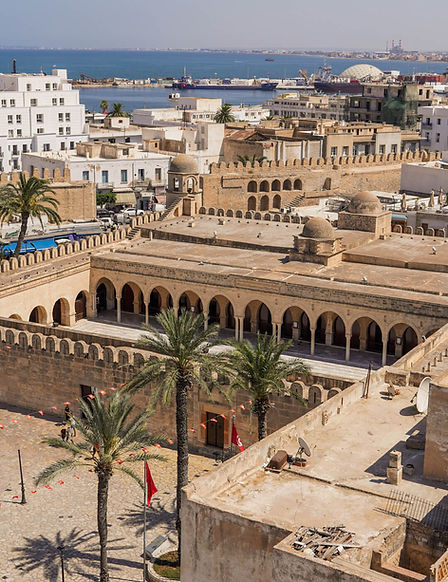
Sousse is a charming coastal city, but its soul lies within the UNESCO-listed Old Medina. We spent the morning wandering through its covered stone pathways and visited the majestic Ribat of Sousse (Entrance: 9 TND for foreign visitors). Climbing to the top of its watchtower offers sweeping panorama views over the city rooftop terraces and the sea.
For lunch, we stopped at Chez Bibichou, a cozy beachfront restaurant popular with locals. The seafood was pulled straight from the sea that morning, served in generous portions, and incredibly affordable, around $10 USD per person for a full fresh fish meal.
After lunch, we drove roughly 2 hours north toward Sidi Bou Saïd. Sitting high on a cliff overlooking the Gulf of Tunis, this iconic town recently achieved UNESCO World Heritage status in July 2026.
We arrived just in time for sunset, checking into 👉Maison Lella Kmar, a wonderfully restored traditional Tunisian riad. Featuring private bathroom suites, a quiet central courtyard, shared living quarters, and a spotless kitchen, it showcased classic Tunisian architecture at its finest.

Day 2 : Sidi Bou Saïd & The Medinas of Tunis
We left the car parked for the day and set out on foot. Sidi Bou Saïd is famous for its bright whitewashed walls, cobalt-blue doors, and bougainvillea-draped archways, here are the highlights we recommend while visiting Sidi Bou Saïd
-
Street Food Must-Tries: Grab a hot Bambalouni (a crispy, sugar-dusted traditional Tunisian donut) for 1,5 TND , followed by a savory Fricassé (a small fried bread roll stuffed with tuna, boiled egg, olives, harissa, and potatoes), also for 1,5 TND.
-
The Iconic View: Head over to Café des Délices. Perched on the cliffside with stepped outdoor terraces, it serves mint tea alongside what is arguably one of the most famous views in North Africa over the Mediterranean Sea.
-
Midday Swim: Walk 20 minutes down the hill (or take a short 5-minute drive) to the beach at the bay of Sidi Bou Saïd for a refreshing dip in the clear water.
Getting lost in the tiny streets of Sidi Bou Saïd was pure magic. We wandered past bright white walls, iconic blue doors, and colorful flowers, capturing amazing photos at every turn. Away from the main crowd, it felt so calm, authentic, and full of genuine local vibes.
For lunch, we dined at Bleue!, a cozy spot serving elevated home-style Tunisian cuisine. Whatever you order, make sure to try their homemade fresh lemonade, it is incredible.
Instead of dealing with capital-city traffic and nightmare parking in central Tunis, we opted for the TGM (Tunis-Goulette-Marsa) commuter train. The station in Sidi Bou Saïd takes you straight to Tunis TGM Station in 25 minutes for under $1 USD.
From the station, take a walk down Avenue Habib Bourguiba, the vibrant heart of modern Tunis lined with French colonial architecture and sidewalk cafés. You will pass the grand Clock Tower before reaching Bab el Bhar (the "Sea Gate"), which marks the official entrance into the ancient Medina of Tunis.
What not to miss inside the Tunis Medina:
-
Al-Zaytuna Mosque: The largest and oldest mosque in the capital (dating back to 732 AD).
-
Souk el Attarine: The traditional market of perfumers and spiced oils.
-
Traditional Rooftop Cafés: Head upstairs at places like Café Panorama for a bird's-eye view over the tiled roofs and minarets of the city.
After 4 hours of soaking in the energy of the capital, we took the TGM train back to Sidi Bou Saïd, caught the sunset over the hills with another bambalouni in hand, and rested at 👉Maison Lella Kmar.


Day 3: Carthage, Kairouan & Return to Monastir
After a homemade breakfast at our riad, we took a short 10-minute drive to the legendary ruins of Carthage. Once the head of a massive maritime empire that rivaled Rome, Carthage remains one of North Africa's most significant historical sites.
The Multi-Site Ticket costs 18 TND (~$6 USD) for foreigners, and it grants access to all major archaeological sites around Carthage.
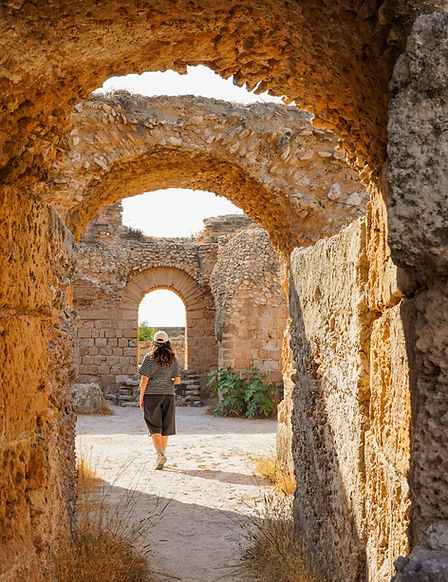
One of the highlights was The Antonine Baths (Baths of Antoninus). Standing right on the edge of the Mediterranean, these were once among the largest bath complexes built in the Roman world. Walking among the massive stone pillars while staring out at the ocean really lets you appreciate the sheer power and scale of ancient Carthage.
Leaving Carthage, we drove 2 hours inland to Kairouan. Founded in 670 AD, Kairouan is considered the fourth holiest city in Islam and was once the ancient capital of Ifriqiya (medieval North Africa).
in 2 to 3 hours, we were able to visit :
-
The Great Mosque of Kairouan (Mosque of Uqba): A masterpiece of early Islamic architecture with a massive, fortress-like courtyard and majestic minaret.
-
The Basin of the Aghlabids: Impressive 9th-century open-air water reservoirs that engineered life in the desert region.
-
Makroudh Tasting: Kairouan is famous across the country for Makroudh, a delicious semolina pastry filled with dates and soaked in honey and orange blossom water.
We grabbed a quick local lunch in town before completing our loop back to Monastir (approx. 1 hour drive).
We returned our rental car in Monastir center and spent our final evening at 👉Hotel Mezri again.
Monastir features a long, beautiful seaside Corniche that comes alive as the sun goes down. Locals gather to stroll along the water, kids play on the promenade, and street food vendors set up shop. It is the perfect, relaxed setting to soak in everyday Tunisian life.
Since our flight back home was scheduled for 6:00 AM the following morning, the front desk team at Hotel Mezri pre-arranged an early airport taxi pick-up for 40 TND (~$15 USD), which made it very convenient for us.


Final Thoughts: Is 4 Days in Tunisia Worth It?
If you want to spend a week trekking through the Sahara Desert sand dunes or lounging on the beaches of Djerba, you will naturally need more time. But if you are working with limited vacation days, a 4-day long weekend in Tunisia is exceptionally doable and rewarding.
Because distances across the northern coast are short, four days felt much longer. We explored two UNESCO heritage sites, walked through century-old medinas, stood inside ancient Roman baths, swam in the Mediterranean, and ate incredible food like Ojja, Kamounia, bambalouni, Fricassé.
Coming from Morocco, we felt an instant connection to Tunisian hospitality and traditions, yet the distinct Mediterranean flavors, unique architecture, and rich layers of history made it a trip all its own.


There are also many full-day arranged and guided tours tours, with hotel pickup in Tunis, Sidi Bousaid and Sousse, if you want to expore trusted local agency we recommend using GetYourGuide as your starting search and booking point :
👉 Hammamet : Carthage, Sidi Bou Said and médina of Tunis with lunch
👉 One Day excursion to the island of Djerba
👉 From Tunis, Hammamet or Sousse : Spend 2 days in the Sahara desert
Install GetyourGuide App and use our code to get 5% discount : SMCHRONICLES5

Is Tunisia Safe ? Practical tips, Rental Cars and Local Transport
Whenever we mentioned we've been to Tunisia, the first question people asked was: "Is it actually safe?"
Having spent 4 days navigating coastal highways, and vibrant medinas, our answer is a yes. Tunisia felt safe, warm, and welcoming.
That said, getting around smoothly comes down to knowing a few local rules of the road, and how to handle taxi drivers!
1. Staying Safe & Avoiding Minor Scams
We never felt unsafe walking around. The main "danger" you’ll face as a tourist isn't crime; it's simply getting overcharged or subtly guided into buying something you don't want.
-
The "Friendly Guide" Trap: Around heavy tourist spots like the Sousse Medina or Carthage, locals might walk up, start chatting, and casually lead you toward a viewpoint or a shop. A polite but firm "Non, merci" or "La, Shukran" right at the start sets clear boundaries.
-
Keep Your Guard Up in Crowds: Like in any major European or North African city, keep an eye on your phone and wallet in crowded markets. Other than basic street smarts, you can relax and enjoy the trip.


2. Renting a Car & Driving: Our Experience
Renting a car was hands down the best decision we made for this itinerary. It gave us total freedom to hit Sousse, Sidi Bou Saïd, Carthage, and Kairouan on our own clock.
-
Book Locally, Not Online: Huge international rental companies charge an arm and a leg online. We walked into a local agency in Monastir center and got a clean, automatic compact car for $45 USD a day, we went with "Sakhri rent a car" company at it was a smooth experience, they have their own website and you can reach out to them before your arrival using WhatsApp.
-
What Driving is Really Like: Main coastal highways are paved and easy to navigate, with bilingual signs in French and Arabic. Tunis city traffic can get chaotic, expect assertiveness, aggressive merging, and scooters darting around, but outside the capital, driving is straightforward. As mentionned earlier, we parked our car in Sidi Bousaid and used local metro line to get to Tunis city center.
-
Police Checkpoints: You will pass through regular police checkpoints on the highway. Don't panic when they wave you down! Officers were always friendly to us. Just hand over your passport, rental agreement, and home driver's license, and you'll be on your way in two minutes.


3. Taxis, Trains & Local Transport
Taxi Negotiations (Don't Get Ripped Off!)
Landing at 11:00 PM in Monastir, we immediately faced the late-night taxi hustle. Drivers will quote high prices, so knowing the going rate is your best superpower:
-
Monastir Airport to Monastir Center: We paid 30 TND (~$10 USD) for the 15-minute ride to Hotel Mezri. Don't pay more than $15 USD.
-
Monastir Airport to Sousse: We met travelers who bargained down to 50 TND (~$17 USD). Anything over $25 USD is an overcharge.
-
In the Cities: Always ask the driver to turn on the meter ("Le compteur, s'il vous plaît"), and follow your trip on google maps
The Train Hacks to Use
-
The $0.35 Airport Metro: If your flight lands before 10:00 PM, skip the taxi entirely! The suburban train station is right outside Monastir terminal, taking you to Sousse or Monastir for just ~1 TND ($0.35 USD).
-
The TGM Train to Tunis: When we visited Tunis from Sidi Bou Saïd, we left our rental car parked and took the local TGM train. It dropped us right near the Medina in 25 minutes for under $1 USD, saving us from horrific city traffic and parking stress.


4. Cash is King: Money Exchange Rules in Tunisia
Tunisia operates under strict currency control laws. The Tunisian Dinar (TND) is a non-convertible closed currency, meaning you cannot buy it outside the country or take it out of Tunisia when you leave.
-
Bring Euros or US Dollars: Cash is used for almost everything, from tipping to paying at small restaurants, markets, and street food stalls. Bring physical cash in Euros (€) or US Dollars ($) to exchange upon arrival.
-
Exchange Offices vs. ATMs: Avoid converting money at foreign exchange counters before your flight. Convert your cash at official exchange desks at the Airport, local bank branches, or official exchange kiosks in city centers. Exchange rates are strictly regulated by the government, so rates remain virtually identical across official locations.
-
Keep Your Receipts! When you convert Euros or Dollars to Dinars, hold onto your exchange receipts. You might need them at the airport bank on your way home if you want to convert unused Dinars back into foreign currency.
-
ATMs: You will find ATMs in major cities, but foreign cards are occasionally declined, and per-transaction limits are relatively low. Carrying cash as a primary backup is essential.

5. Mobile Data: Staying Connected Seamlessly
Having mobile data is crucial for navigating Google Maps through medinas, tracking live locations
-
The eSIM Solution: Instead of waiting in long airport lines, handing over your passport at a local kiosk, and swapping physical SIM cards, setting up data ahead of time makes landing hassle-free.
-
How We Managed Data: Before flying, we installed an 👉Airalo eSIM for Tunisia. It connects to local networks the moment your flight touches down, meaning you have instant internet to coordinate airport transfers, check map directions, or look up translation phrases right at arrival.
-
Data Packages: Small 1 GB to 5 GB packages are very affordable and more than enough for a 4-day long weekend.


How Cheap is Tunisia? our 4-Day Trip Budget Breakdown
When we were planning our long weekend, one of the biggest questions on our mind was just how far our money would stretch. After four days on the road, the short answer is that Tunisia is one of the best-value Mediterranean destinations you can visit right now
We pull together for you our exact budget breakdown so you know what to expect when planning your own trip.
Transportation & Flight Costs
Getting there was easily our best deal. We scored direct round-trip flights from Paris Orly to Monastir for €150 ($165 USD) per person.
Once on the ground, transportation stayed incredibly affordable. Renting an automatic compact car from a local agency in Monastir ran us $45 USD per day (so $135 USD total for three days), which was worth the freedom it gave us to hit four different regions. Gas across the whole trip added roughly $25 to $30 USD.
When we didn't use the car, transport costs dropped to almost nothing:
-
Late-night airport taxi: 30 TND (~$10 USD) to Monastir center.
-
TGM train from Sidi Bou Saïd to Tunis: Under $1 USD round trip.
-
Early morning departure taxi: 40 TND (~$15 USD) pre-arranged by our hotel.
Accommodation
Where you stay in Tunisia can easily adapt to your budget. We split our nights between two very different styles of stays:
👉Hotel Mezri (Monastir): A standard, budget-friendly coastal hotel that gave us a clean bed and breakfast for a great price right by the sea, 50$ per night
👉Maison Lella Kmar (Sidi Bou Saïd): A gorgeous, upscale renovated traditional riad. While a unique boutique stay like this costs more, it felt like a luxury experience that costs 90$ per night
Food, Drinks & Snacks
Eating out was one of the highlights of our trip, both for our tastebuds and our wallets.
-
Street food snacks: Crispy bambalouni donuts in Sidi Bou Saïd and fresh fricassé sandwiches cost barely 2 to 4 TND ($0.70 to $1.30 USD) each.
-
Sit-down lunches: Our fresh fish feast at Chez Bibichou in Sousse came out to roughly $10 USD per person, including huge portions and salad. Cozy local spots like Bleue! in Sidi Bou Saïd were similarly affordable.
-
Cafés: Drinking mint tea or a juince with a panoramic sea view at Café des Délices cost less than 30 TND ($10), other local cafés are cheaper and costs around 10 TND ($3)
Sightseeing & Entrance Fees
Historic sites in Tunisia are surprisingly cheap compared to Europe:
-
Ribat of Sousse: 9 TND (~$3 USD) per ticket for foreign visitors.
-
Carthage Ruins: 18 TND (~$6 USD) for a combined ticket that opens up all major Roman and Punic sites, including the Antonine Baths.
The Grand Total: What a 4-Day Trip Costs for 2 Travelers (Excluding Flights)
For the two of us, our total trip expenses for 4 days came out to roughly $600 USD combined ($300 USD per person).
If you are traveling as a pair, a 4-day long weekend in Tunisia is one of the highest-value road trips you can take in the Mediterranean.
At just ~$300 USD per person on the ground, splitting shared costs like car rentals and accommodation allowed us to balance budget-friendly stops with boutique luxury stays, all while eating top-tier fresh seafood, exploring world-class historical sites, and sipping mint tea over cliffside views. You don't need a massive budget or weeks of paid time off to have an amazing North African adventure; a quick 4-day loop as a couple is more than enough to fall in love with Tunisia.


Top Tunisian Food you must Try
Tunisian cuisine surprised us in the best way possible. Coming from Morocco, we felt an instant familiarity with the North African spices, but the heavy Mediterranean influences, fresh seafood, and signature spicy harissa gave every dish its own distinct personality. We spent four days eating our way through seaside restous, fast-food street stalls, and cozy local spots.
Here are the absolute best Tunisian foods you need to try on your trip, along with what we actually paid for them.
Fricassé
These bite-sized savory rolls became our go-to snack whenever we needed a quick burst of energy between sightseeing stops.
-
What it is: A soft, lightly fried miniature bread roll stuffed with mashed potatoes, hard-boiled eggs, flaky tuna, black olives, and a spicy swipe of harissa.
-
Price: Around 1.5 TND (~$0.50 USD) per sandwich. Ordering four to six of these little flavor bombs easily makes a full, satisfying meal for under $3.
Bambalouni
You cannot visit Sidi Bou Saïd without grabbing a hot, fresh Bambalouni to enjoy while strolling down the blue-and-white streets.
-
What it is: A traditional Tunisian golden-fried donut made right in front of you, served burning hot in paper and dusted heavily with granulated sugar (or slathered in Nutella if you're feeling extra sweet).
-
Price: Just 1.5 TND (~$0.50 USD). It’s crispy on the outside, light and airy on the inside, and pure magic to eat while looking out over the sea.
Ojja (Ojja Bil Merkour / Seafood)
We ordered this comforting skillet dish during a chilly afternoon, and it quickly became one of our favorite comfort foods of the trip.
-
What it is: A rich, bubbling tomato and red pepper stew laced with eggs, garlic, and local spices, cooked in a traditional clay dish. You can get it vegetarian, packed with spicy merguez beef sausage, or stuffed with fresh local seafood.
-
Price: Typically 20 to 30 TND (~$6.50 to $10 USD) depending on your choice of protein.
Kamounia
If you want to taste a dish that showcases traditional Tunisian spicing, this is it.
-
What it is: A deeply flavorful, slow-cooked stew heavily seasoned with ground cumin (kamoun) and garlic, served with your choice of octopus, beef, or chicken alongside crusty bread for dipping.
-
Price: Around 20 to 30 TND (~$6.50 to $10 USD).
Brik à l'Œuf
No meal in Tunisia feels complete without ordering a crispy, freshly fried Brik as an appetizer.
-
What it is: Paper-thin pastry folded over a filling of raw egg, parsley, onions, tuna, and harissa, deep-fried until golden so the center egg yolk stays warm and runny when you bite into it.
-
Price: 3 to 5 TND (~$1.00 to $1.60 USD).
Slata Mechouia
You will find this served alongside almost every main dish in the country.
-
What it is: A smoky grilled salad made of charred sweet red peppers, tomatoes, garlic, and onions mashed together with olive oil, caraway, and topped with canned tuna and hard-boiled eggs.
-
Price: 5 to 8 TND (~$1.60 to $2.60 USD) as a starter.
Fresh Mediterranean Seafood
Since we spent much of our time along the coast in Monastir and Sousse, eating fresh fish was an absolute highlight, especially our meal at Chez Bibichou.
-
What it is: Fresh daily catches (sea bream, sea bass, red mullet, or grilled prawns) lightly seasoned with olive oil and local herbs, served alongside crispy fries and mechouia salad.
-
Price: A massive, fresh fish platter costs around 30 TND (~$10 USD) per person, offering unbelievable value for seaside Mediterranean dining.
.jpeg)
.jpeg)